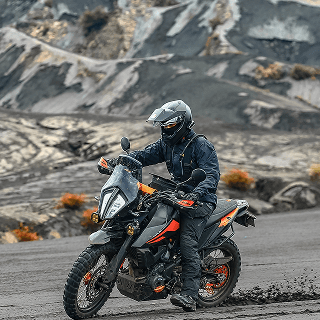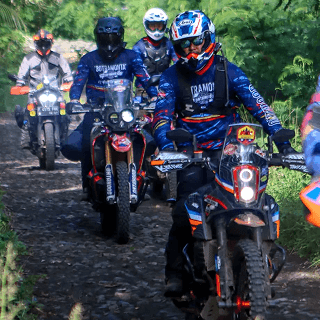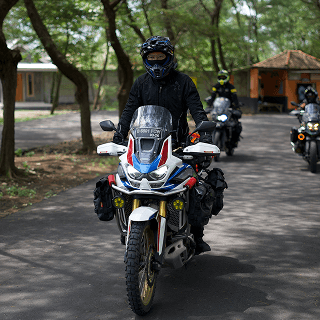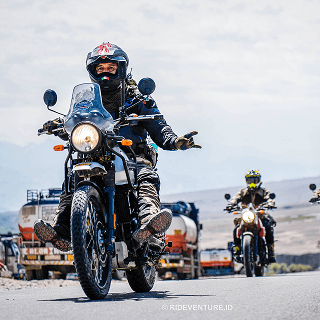
A group of riders navigating the dramatic mountain passes of Ladakh, where the road meets the sky.
Ladakh is not merely a destination—it is a test of spirit. At 3,500 meters above sea level, the air grows thin and the landscape opens into a vast theater of rock, ice, and sky. Every kilometer demands respect, and rewards it tenfold.
The journey begins in Leh, the ancient capital perched in the Indus Valley. From here, the road climbs through a series of high passes—Khardung La, Chang La, Tanglang La—each a gateway to landscapes that defy description. Barren mountains striped in ochre and rust give way to turquoise lakes mirroring snow-capped peaks.
Ladakh offers some of the world's most legendary high-altitude riding. The Border Roads Organization maintains ribbons of asphalt that snake through terrain where roads have no business existing. Khardung La at 5,359 meters is often cited as the world's highest motorable pass—though the real thrill lies in the lesser-known passes where you ride alone with the wind.
The region's unique geography creates microclimates that shift within kilometers. One moment you're crossing a barren plateau under scorching sun; the next, you're descending into a green valley where apricot orchards bloom beside glacial streams. This variety, compressed into a single day's ride, is what makes Ladakh incomparable.
Day 1–2: Acclimatize in Leh (3,500m). Visit Thiksey and Hemis monasteries, ride to Magnetic Hill and Sangam (confluence of Indus and Zanskar).
Day 3: Leh to Nubra Valley via Khardung La (5,359m). Descend to Hunder's sand dunes and Bactrian camels. Overnight in Diskit.
Day 4: Nubra to Pangong Tso via Shyok River route. The lake's shifting blues—azure to emerald to deep indigo—stretch 134 km into Tibet.
Day 5: Pangong to Hanle via Chushul. Remote Changthang plateau, nomadic camps, and the Indian Astronomical Observatory at 4,500m.
Day 6: Hanle to Tso Moriri. Korzok monastery, black-necked cranes, and the mirror lake at 4,522m.
Day 7: Tso Moriri to Leh via Tanglang La (5,328m). Final ascent, then descent to the Indus Valley.
Royal Enfield Himalayan 450 or Honda CRF300L Rally are ideal—light, torquey, and proven at altitude. For bigger bikes, BMW GS 1250 or KTM 1290 Adventure R with lowered suspension.
Mandatory: DOT/ECE helmet, CE-rated armor (shoulders, elbows, back, knees, hips), waterproof Gore-Tex suit, insulated gloves, neck brace. Heated grips and vest strongly recommended.
Carry: tire repair kit, spare tubes, chain lube, basic tools, first aid, Diamox (altitude sickness), water purification, high-calorie snacks. Satellite messenger (Garmin inReach) for remote stretches.
June to September is the only viable window. June–early July: passes just opened, snow walls on Khardung La, fewer tourists. Mid-July–August: monsoon in lower Himalayas keeps Ladakh dry and warm (15–25°C day), wildflowers in bloom. September: crystal clear skies, golden light, cold nights (near 0°C), minimal traffic.
Avoid October–May: passes closed by snow, temperatures -20°C to -30°C, roads impassable.